Watercolor Monster House Clipart for Creative Projects
If you have ever scrolled past another cartoonish haunted house and felt that familiar tug of disappointment, you are not alone. Most monster-themed graphics lean too young or too dark, leaving a gap for something with warmth, texture, and genuine character. That is exactly where Watercolor Monster House Clipart PNG steps in. This set of hand-painted, whimsically spooky house illustrations brings a soft, storybook quality to projects that need personality without sacrificing polish.
What Makes Watercolor Monster House Clipart Stand Out
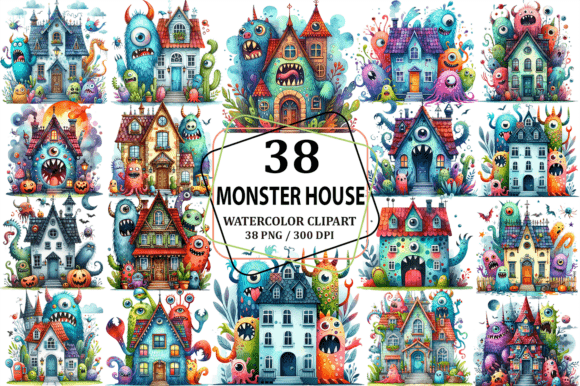
At first glance, these are not your typical flat vector icons. Each house carries the organic texture of real watercolor pigment—subtle gradients, uneven edges, and gentle color blooms that digital-only assets struggle to replicate. The monster theme is playful rather than frightening: crooked chimneys, wobbly windows, friendly shingles, and exaggerated rooflines that feel alive. The PNG format preserves transparency, so you can drop these into any background without clipping or hard white borders.
The color palette leans toward muted purples, dusty greens, warm oranges, and charcoal blues—colors that feel seasonal without shouting Halloween. That restraint is intentional. It means the clipart works across autumn branding, fantasy editorial design, or even children’s book layouts without feeling dated or overly thematic. The watercolor texture also introduces a handmade authenticity that flat design often lacks, making each element feel like a crafted piece rather than a cookie-cutter asset.
Where This Clipart Shines in Real Projects
The practical range of Watercolor Monster House Clipart PNG is broader than you might expect. Here is where it tends to deliver strongest results:
Branding and Logo Design
Small businesses in the creative, seasonal, or children’s niches benefit enormously from assets that feel bespoke. A bakery with a fall-themed pop-up, a boutique toy shop, or a local event planner running a spooky harvest fair can use these houses as logo elements, social media headers, or product badges. The watercolor texture lends a craft-culture feel that signals quality and care. When you place one of these houses next to a clean sans serif font, the contrast creates immediate visual hierarchy. The organic, soft clipart draws the eye first, while the type carries the message.
Editorial Design and Blog Graphics
Bloggers and digital publishers covering seasonal decor, slow living, or children’s activities need imagery that supports their voice without overwhelming it. These houses work beautifully as pull-quote backgrounds, section dividers, or full-width hero illustrations. Because the PNG files are transparent, you can layer text directly over the lighter wash areas and maintain strong readability. The hand-painted feel also helps content feel less sterile—a welcome quality in a landscape overrun with generic stock photography.
Packaging and Merchandise
Product designers, Etsy sellers, and small-batch manufacturers can use this clipart for tags, labels, wrapping paper, and sticker sheets. The monster houses look especially fitting on candle labels, tea tins, stationery sets, and fabric patches. Since the artwork is already rasterized in PNG format, you can place it directly into print templates without additional rendering. Just be mindful of resolution: these are pixel-based files, so scaling them up too aggressively may soften the detail. For typical packaging dimensions, though, the quality holds well.
Social Media and Web Design
Marketers and content creators often need cohesive visual systems that move across Instagram, Pinterest, and website banners. The moody but friendly aesthetic of Watercolor Monster House Clipart PNG carries well in square social posts, story backgrounds, and email headers. Because the watercolor texture is inherently soft, it does not compete with bold typography or call-to-action buttons. Instead, it provides a visual foundation that feels intentional and curated.
How the Design Style Influences Brand Perception
Every design asset you use sends a signal. A crisp, geometric vector says modern and efficient. A heavily textured grunge graphic says raw and rebellious. A watercolor illustration says handcrafted, thoughtful, and approachable. That middle ground is powerful for brands that want to feel professional yet warm. The monster houses, with their uneven edges and subtle paint bleeds, communicate that someone spent time creating something unique.
From a visual hierarchy standpoint, these assets work best when used as accent elements rather than all-over patterns. One large house as a hero image or a cluster of smaller houses in a corner layout draws the eye without overwhelming the composition. The transparency of the PNG format makes layering intuitive, so you can place a house behind a headline or overlapping another graphic element to create depth. This kind of layered, dimensional design reads as modern and editorial, even when you are working with a modest skill set.
Consistency matters, too. If your brand identity leans toward earthy, handcrafted, or vintage-tinged visuals, this clipart reinforces that direction. Pair it with a handwritten script font or a soft serif to maintain cohesion. Avoid pairing it with stark, geometric typefaces or neon colors—the clash tends to confuse the emotional tone rather than create exciting contrast.
Practical Guidance for Choosing and Using the Right Assets
Before you download and start layering, take a moment to evaluate fit. Here are the considerations that separate a solid design choice from a mismatch:
Assess Your Project’s Visual Personality
Ask yourself what feeling the final piece needs to carry. If you are designing for a horror-themed escape room, these houses may feel too friendly. If you are designing a children’s activity book about friendly monsters, they are a near-perfect match. For seasonal marketing or autumn branding, the muted palette and playful forms fit naturally. Be honest about whether the watercolor texture aligns with your audience’s expectations. A corporate client with a clean, clinical brand will likely struggle to integrate this style. A creative entrepreneur or niche publisher will find it immediately useful.
Test Pairings with Your Existing Type and Graphics
Drop one of the PNG files into your layout alongside your current typeface choices. Notice how the soft edges interact with the type. If you are using a bold sans serif, you may need to add subtle shadow or outline effects to help the text stand out. If you are using a delicate script, the watercolor texture can support it without competition. These houses also pair well with simple line art, hand-drawn icons, and botanical illustrations. They tend to clash with highly detailed vector patterns or high-contrast photography.
Review the Included Styles and Format
Not all clipart sets are created equal. Check how many variations are included, what color versions are available, and whether the resolution meets your output needs. For web and social media, standard resolution PNG files work fine. For print projects like posters, flyers, or product packaging, look for files at 300 DPI or higher. Transparency is already handled in the PNG format, so you do not need to worry about background removal. However, you should test the files in your design software to confirm the alpha channel is intact and no residual white fringing appears around edges.
Understand the Licensing Terms
Commercial use licensing varies widely across design asset marketplaces. Some sets allow unlimited commercial use, while others restrict usage to a certain number of products or require attribution. Before you build a brand identity or product line around Watercolor Monster House Clipart PNG, confirm the license covers your intended use cases. If you are a small business owner or freelancer, look for extended commercial licenses that permit merchandise, digital products, and print-on-demand items. Attribution requirements can be cumbersome in client work, so check whether credit is mandatory.
Practical Recommendations for Getting the Most Out of the Asset
Once you have the files ready, treat them as physical objects rather than digital placeholders. Experiment with scale, rotation, and overlapping to create scenes that feel composed rather than placed. Layer a smaller house behind a larger one, add a subtle shadow drop to create depth, or duplicate a house and change the opacity to build a ghostly background element. Because these are watercolor textures, you can also blend them using multiply or overlay layer modes in Photoshop, Canva, or Affinity to create unexpected color interactions.
For social media graphics, consider using a single house as a profile frame or highlight icon. For blog post featured images, center one house against a solid pastel background and overlay your title in a complementary typeface. For product labels, place a small house near the corner or edge to create a decorative seal effect. The key is restraint: one or two well-placed elements carry more weight than a crowded layout.
The best projects using this style treat the clipart as an anchor for the visual identity, not as filler. When you give the art room to breathe, the handmade texture and playful silhouette do the heavy lifting. Your audience will perceive the time and thought behind the design, even if they cannot articulate exactly why it feels more engaging than a standard stock graphic.
Ultimately, Watercolor Monster House Clipart PNG occupies a specific and valuable niche: it brings warmth, texture, and character to projects that need to feel handmade without looking amateur. For designers, small business owners, and content creators who work in seasonal, children’s, or lifestyle spaces, it is the kind of asset that quietly elevates everything around it.